Request a quote
Pricing depends on configuration, quantity and your requirements.
Laser Welding Machine for Jewellery - 200W Pulsed YAG Welder
Joins gold, silver and platinum under a 10x microscope, with a weld spot you set from 0.2 mm. The heat stays where you aim it, so set stones stay in.
✔ 200 W pulsed YAG - 150 J in one pulse, for deep welds on thick stock
✔ Spot 0.2 to 3.0 mm - a prong tip and a bangle joint on one machine
✔ 10x microscope and CCD - you see the joint on screen as you weld
✔ No stone removal - the pulse is over before heat reaches the setting
✔ Chiller inside the cabinet - nothing separate to plumb in beside it
✔ Single-phase 220 V - an ordinary workshop point, and it is on castors
For repair counters, karigars and manufacturing units. Installation and training included.
WhatsApp +91 98216 12340 · Semsons Tech, since 1978.
Share your requirement and our team will send you pricing, availability and a quotation.
Security policy
Delivery policy
Return policy
Weld a prong, a chain link or a ring shank with the stones still in the piece.
A torch heats everything around the joint. On a set piece that means pulling the stones, soldering, then setting them again - and on an emerald, an opal or a treated stone it can mean turning the job away. This welder puts its energy into a spot as small as 0.2 mm, and each pulse is over in thousandths of a second, so the heat has no time to travel down the shank to the setting. You look through a 10x microscope, put the joint on the crosshair and fire. Gold in every karat, silver and platinum all take the weld.
A power supply fires the YAG rod inside the cabinet and it gives out a pulse of light at 1064 nm. The optics focus that pulse onto the joint. Each pulse carries up to 150 joules and lasts between 0.1 and 20 milliseconds, which melts a small pool of metal at the spot. The pool closes the joint and freezes again before the heat has spread. Argon blows across the spot while it is molten, so the weld comes out bright instead of oxidised black.
| The job | What the laser does |
|---|---|
| Ring resizing | Closes the shank after sizing, with the stones left in the head |
| Broken or worn prongs | Builds the prong tip back up and re-tips it in place |
| Chain and clasp repair | Joins a link or a jump ring without flooding the run with heat |
| Porosity in a casting | Fills the pit with a pulse of the parent metal, then dresses it flush |
| Bezel and gallery work | Tacks and closes fine sections a torch would collapse |
| Building metal up | Adds material with filler wire where a piece has worn thin |
| Tacking before soldering | Holds two parts in register so nothing shifts in the flame |
| Hollow and thin-wall pieces | Welds sheet too thin to hold a torch on |
Gold in every karat, yellow, white and rose. Silver. Platinum and palladium. The weld is the parent metal fused to itself, so it takes the same polish and finishes the same colour as the rest of the piece.
Silver is the one metal that asks for more from the machine. It reflects 1064 nm light and it carries heat away fast, so a silver weld needs more energy in the pulse than the same joint in gold. That is a setting on the panel, not a limit on the machine.
Keep the beam off the stone itself. A short pulse a few millimetres away from a setting is the point of the machine, but a stone put directly under the beam will be damaged, the same as under any other heat source.
| Parameter | Specification |
|---|---|
| Type | Pulsed YAG laser welding machine for jewellery |
| Laser source | YAG single-doped laser |
| Wavelength | 1064 nm |
| Output power | 200 W |
| Single pulse energy | 150 J |
| Pulse width | 0.1 to 20 ms |
| Pulse frequency | 0.1 to 20 Hz |
| Focal spot diameter | Adjustable, 0.2 to 3.0 mm |
| Viewing system | 10x microscope with CCD camera |
| Control system | Integrated visual operating system |
| Cooling | Chiller built into the cabinet, with air cooling |
| Shielding gas | Argon nozzle built in; cylinder and regulator arranged locally |
| Power supply | Single phase, 220 V / 50 Hz |
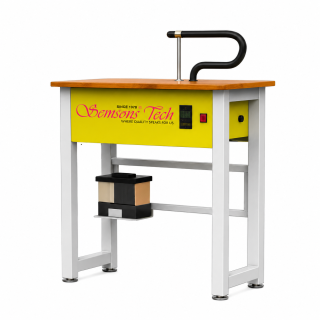
| Cabinet | Floor-standing, on castors |
| Warranty | 12 months, extendable |
| Installation | On-site by a Semsons technician |
| Training | On-site operator training included |
That is what the machine is for. The pulse lasts thousandths of a second and the spot can be as small as 0.2 mm, so the heat is spent before it travels down the shank to the setting. Aim at the metal, keep the beam off the stone, and the stone stays where it is.
Not from a weld a few millimetres away - the heat does not reach that far in the time the pulse lasts. A stone put directly in the beam will be damaged. On emerald, opal, pearl and treated stones, keep the weld further off and use lower energy per pulse.
Yes, for a clean weld. The argon nozzle is built into the machine; you arrange the cylinder and regulator locally, which is the cheaper way round because industrial argon is sold everywhere in India. The gas keeps oxygen off the molten spot, so the weld comes out bright rather than black and pitted.
A single-phase 220 V, 50 Hz supply. There is no three-phase point to have run in.
No. The chiller is inside the cabinet, along with air cooling. There is no external unit to stand next to the machine and no water to plumb in.
Yes, with more energy in the pulse than the same joint in gold. Silver reflects 1064 nm light and conducts heat away quickly, so it takes a stronger setting. Everything else about the job is the same.
Yes. Platinum, palladium and the white gold alloys all weld, and because the weld is the parent metal fused to itself, the joint finishes the same colour as the piece and takes rhodium the same way.
No, and that is the advantage. Solder is a separate, lower-melting alloy sitting between two pieces of metal, and it can show as a line of a different colour. A laser weld fuses the parent metal to itself, so there is no third alloy in the joint and nothing to show up after polishing.
For a tight butt joint, no - the two edges melt into each other. For a gap, a worn section or building metal back up, feed a matching filler wire into the spot as you pulse.
It is a floor-standing cabinet on castors, so it rolls to wherever the work is and needs a power point plus room for the operator to sit at the microscope. Send us a WhatsApp for the exact footprint before you plan the bench.
It is an industrial laser and it is handled like one. Nobody should run it before the training, which covers eye protection and safe handling and is done on site by the technician who installs the machine. Keep the work under the microscope and keep hands out of the beam path.
After welding and dressing the joint, most workshops run the piece through an Ultrasonic Cleaner to lift polishing compound and residue out of the setting before it goes back to the customer.
Old gold that came in over the counter can be anything, and an unknown alloy takes a different pulse setting from the one you last used. Check the piece on a gold analyzer first, then set the machine for what it actually is.
Yes. A Semsons technician installs the machine on your floor, sets it up and trains your operator on it. What that covers is set out on the installation, training, spares and service page.
Price is quoted per configuration. Send us a WhatsApp message with the kind of work you do - repairs, chain, casting rectification, or all three - and we will quote the right unit. On-site installation and operator training are included. 12-month warranty, extendable with an annual maintenance contract. EMI options are available through partner banks. Genuine spares and service across 16+ Indian cities.
Sales: WhatsApp +91 98216 12340 | Wholesale: WhatsApp +91 80823 38010
Semsons Tech - Where Quality Speaks For Us. Since 1978.
Items this product is listed as working with.
check_circle
check_circle