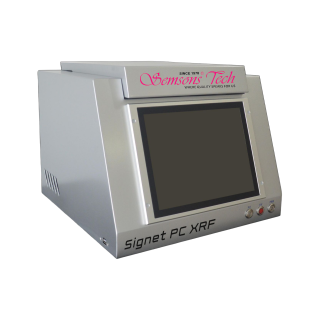
Gold Analyzer XRF Signet - PC
Request a quote
View Gold Analyzer XRF Signet - PC
Request a quote
Pricing depends on configuration, quantity and your requirements.
Gold Analyzer XRF Signet FSDD
The benchtop Signet for work where the number is written down afterwards - a hallmarking certificate, a refinery report, an export document.
✔ 72 elements - gold, silver, platinum, palladium and the rest of the list
✔ ±0.10% on gold - across a 1% to 99.99% analysis range
✔ 145 ± 15 eV detector - finer than the Signet Si-Pin's 165 ± 5 eV
✔ Solid, powder or liquid - all three go in the same chamber
✔ 10 to 60 seconds - 40 seconds for the best reading
✔ Nothing touches the piece - no acid, no filing, no marks
For hallmarking centres, refiners, bullion traders and laboratories. Installation and operator training included.
WhatsApp +91 98216 12340 · Semsons Tech, since 1978.
Share your requirement and our team will send you pricing, availability and a quotation.
Security policy
Delivery policy
Return policy
A benchtop X-ray fluorescence analyzer that reads 72 elements and holds gold to ±0.10%, without cutting, dissolving or marking the sample.
An XRF gold analyzer tells you what a piece of metal is made of by reading the X-rays it gives back, so the piece comes out of the machine exactly as it went in. The Signet FSDD is the bench model Semsons supplies for the work where that figure has to stand up later - karat certification, refined output going out of the door, an export consignment a buyer will re-test at the other end. It reads from 1% to 99.99% gold, reports up to 72 elements alongside it, and takes solid pieces, powder and liquid in the same 368 × 298 × 86 mm chamber.
The machine aims an X-ray beam at the sample. Every element answers back with X-rays at its own energy, and the detector sorts those answers by energy while the software counts them. The count gives the percentage of each element present, and the karat follows from the gold figure. The FSDD's detector separates energies to within 145 ± 15 eV, so two elements whose energies sit close together are counted apart rather than added together as one.
Powder and liquid samples sit in a sample cup. There is nothing to prepare and no chemical to handle.
| Point of difference | The Signet FSDD |
|---|---|
| Gold tolerance | ±0.10% on gold content |
| Detector | Silicon PIN, resolving to 145 ± 15 eV, against 165 ± 5 eV on the Signet Si-Pin |
| Elements reported | 72, including the platinum-group metals |
| Sample forms | Solid, powder and liquid |
| Computer | Runs from your own PC or laptop, where the touch-screen models carry the computer inside the machine |
| Sample chamber | 368 × 298 × 86 mm - wider and longer than the Si-Pin's 300 × 300 mm, and 86 mm deep |
| Bench weight | 40 kg |
| What you need to settle | What the analyzer reports |
|---|---|
| The karat of a piece | The gold percentage, and the karat that follows from it, to ±0.10% |
| What else is in the alloy | Up to 72 elements - silver, copper, zinc, nickel, cobalt, iron and the rest, each as a percentage |
| Platinum-group content | Platinum, palladium, rhodium, iridium, ruthenium, osmium and rhenium are all on the element list |
| Lead or cadmium in an export order | Both are reported when they are present in the analysed volume |
| Whether refined output meets its specification | The gold figure and the impurity breakdown, before the lot is dispatched |
| A purity figure a customer disputes | A printed report with the element breakdown behind it, rather than a judgement call |
XRF reads the composition of the surface volume it measures. It is a measurement of what is in front of the detector, which is what makes it the right tool for karat and alloy work - and the reason a piece of unknown origin is still worth a second opinion before a large purchase.
Gold bars, biscuits and coins. Refined output before dispatch. Rings, chains, bangles, necklaces and earrings, including pieces with stones set in them. Scrap and old gold. Silver, platinum, palladium and the other platinum-group metals. Plating and karat solutions, and powder samples, in a sample cup. Anything that fits a 368 × 298 × 86 mm chamber and offers a flat area of 1 to 2 mm for the beam to sit on.
| Parameter | Specification |
|---|---|
| Model | Signet FSDD |
| Technology | X-ray fluorescence (XRF), non-destructive |
| Detector | Silicon PIN |
| Detector resolution | 145 ± 15 eV |
| Accuracy | ±0.10% on gold content |
| Analysis range | 1% to 99.99% |
| Elements read | 72, including gold, silver, platinum, palladium, iridium, rhodium, ruthenium, osmium, rhenium, copper, nickel, zinc, cobalt, iron, manganese, tungsten, lead and cadmium |
| Sample forms | Solid, powder and liquid |
| Test time | 10 to 60 seconds, 40 seconds for the best reading |
| Test spot | 1 to 2 mm diameter |
| X-ray source | Triple-stage tungsten (W) target X-ray tube |
| High-voltage supply | 0 to 50 kV |
| Tube current | 0 to 1000 µA |
| Camera | Built-in HD camera for positioning |
| Computer | Runs from your own PC or laptop |
| Connectivity | USB and Ethernet, printer support |
| Sample chamber | 368 × 298 × 86 mm |
| Dimensions | 615 × 418 × 315 mm |
| Net weight | 40 kg |
| Operating temperature | 0°C to 35°C |
| Operating humidity | Below 70% |
| Power | 230 V, 50 Hz |
| Safety | Shielded sample chamber with a door interlock - the X-ray stops when the door opens |
| Warranty | 1 year, extendable |
| Installation | On-site by a Semsons technician, with calibration against reference samples |
| Training | On-site operator training included |
It holds gold content to ±0.10%, across an analysis range of 1% to 99.99%. The detector resolves to 145 ± 15 eV, which is what lets it keep two elements apart when their energies sit close together on the spectrum.
Between ten and sixty seconds, and you choose. Ten seconds is enough to settle a quick question at the counter. Forty seconds is the figure the catalogue gives for the best reading, and it is the one to use when the number is going onto a certificate or a dispatch note.
Seventy-two. Alongside gold it reports silver, platinum, palladium, iridium, rhodium, ruthenium, osmium, rhenium, copper, nickel, zinc, cobalt, iron, manganese, tungsten, lead and cadmium, among others - each as a percentage of the analysed volume.
All three. Solid pieces go straight into the chamber; powder and liquid samples go in a sample cup. That covers refining sweeps, filings, and plating and karat solutions as well as finished jewellery and bars.
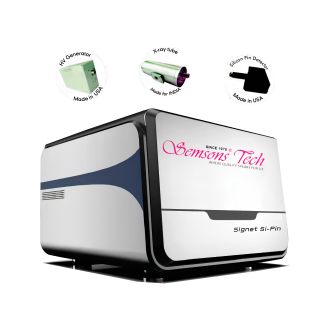
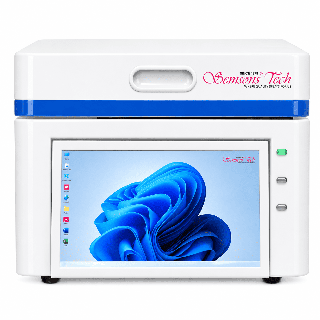
Yes. This model has no screen of its own and runs from your PC or laptop over USB or Ethernet, with printer support for the report. If you would rather the computer and screen were built into the machine, the Gold Analyzer XRF Signet Si-Pin with Touch Screen and the Gold Analyzer XRF Signet - PC are the two to look at.
The FSDD resolves to 145 ± 15 eV where the Signet Si-Pin resolves to 165 ± 5 eV, and it is the larger machine at 40 kg with a 368 × 298 × 86 mm chamber against the Si-Pin's 25 kg and 300 × 300 × 100 mm. The Si-Pin reads from ppm upwards, so trace work at very low concentrations is its ground. Tell us the samples and the volumes and we will say which of the two fits.
No. Nothing touches the piece, and no acid, file or drill is used. The customer's item comes back exactly as it went in, which is the whole reason a showroom can test in front of the customer.
Yes. The HD camera shows the test spot before the machine runs, so you place the beam on an open area of metal and away from the stone. The stones do not have to be removed.
The sample chamber is shielded and the door is interlocked - the X-ray stops the moment the door opens, and the machine will not run with the door open. For the radiation paperwork that applies at your premises, ask us and we will send the current documentation for this model rather than have you work from a figure on a web page.
The chamber measures 368 × 298 × 86 mm, so the limit in practice is height: 86 mm of clearance takes bars, biscuits, coins, chains, rings and most bangles laid flat. The machine itself is 615 × 418 × 315 mm and weighs 40 kg, so it wants a solid bench rather than a light counter.
No separate room and no extraction. It runs from a normal 230 V, 50 Hz supply and sits on a bench. Keep the room between 0°C and 35°C with humidity below 70%, which is what the specification asks for.
Yes. A Semsons technician installs the machine, calibrates it against reference samples and trains your operator on site. What is covered afterwards - spares, calibration checks and service visits - is set out on the installation, training, spares and service page.
Price is quoted per configuration, because the software options and the reference samples supplied with the machine change the figure. Send us a WhatsApp message with your daily testing volume, your sample types and the standard you report to, and we will quote the right setup. On-site installation, calibration and operator training are included. 1 year warranty, extendable with an annual maintenance contract. Calibration reference samples and spares are stocked. EMI options are available through partner banks. Service across 16+ Indian cities.
Sales: WhatsApp +91 98216 12340 | Wholesale: WhatsApp +91 80823 38010
Semsons Tech - Where Quality Speaks For Us. Since 1978.
Items this product is listed as working with.
Request a quote
View Gold Analyzer XRF Signet - PCRequest a quote
View Gold Analyzer XRF Signet Si-Pincheck_circle
check_circle