Gold Analyzer XRF Signet - PC
Request a quote
View Gold Analyzer XRF Signet - PC


Semsons Tech
Request a quote
Pricing depends on configuration, quantity and your requirements.
Gold Coin Testing Machine
Reads the electrical conductivity of a gold coin, bar or bullion piece and tells you whether it matches what that piece is meant to be. Nothing is scratched, filed or dipped.
✔ A reading in seconds - on screen while the customer waits
✔ Catches tungsten cores - tungsten reads about 18.8 MS/m, fine gold about 45
✔ Reads through capsules - sealed coins stay sealed, up to 3 mm of packaging
✔ No damage to the piece - no acid, no filing, no marks
✔ Coins from about 1/4 oz - and bars from 10 g
✔ Over 10 hours per charge - battery, so it travels
It screens whether a piece is genuine. It does not report a karat number - for that, see the XRF analyzer.
WhatsApp +91 98216 12340 · Semsons Tech, since 1978.
Share your requirement and our team will send you pricing, availability and a quotation.
Security policy
Delivery policy
Return policy
Tells you whether a gold coin or bar is what it claims to be, without opening the capsule or marking the metal.
Someone puts a sealed one-ounce coin on your counter. The capsule carries part of its value, so you cannot open it, and acid would ruin the piece anyway. This instrument reads the metal through the capsule. You tell it what the coin is supposed to be, rest it on the measuring face, and the conductivity comes up on screen next to the value that alloy should give. A tungsten-filled fake cannot match that number, because tungsten carries current less than half as well as gold.
The instrument puts a small magnetic field into the piece. That field stirs eddy currents in the metal, and how freely those currents flow depends on what the metal actually is. The reading is shown as electrical conductivity, in MS/m. Fine gold sits near 45 MS/m. Silver sits near 61. Tungsten, the metal used to fill counterfeit bars, sits near 18.8. A piece that does not read where its alloy should read is the warning.
| What you get | |
|---|---|
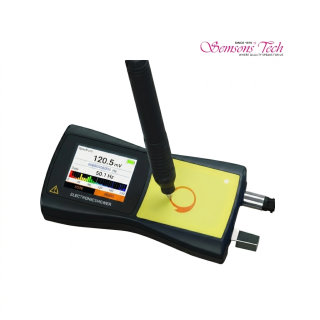
| Sensor pad | The coin or bar lies flat on a 20 mm measuring field. Coins from about 1/4 oz and bars from 10 g, up to roughly 2 oz or 50 g. |
| Pen | A very small measuring coil in a tip you rest on the piece. Coins and small bars up to about 1 oz, and it reaches surfaces a flat pad cannot - irregular shapes and silver cutlery. |
| Reach into the metal | About 0.65 mm from each side on .900 and .916 gold on the sensor pad; about 0.7 mm on the pen. |
| Through packaging | Both read through capsules, blisters and foil up to about 3 mm, so sealed bullion stays sealed. |
| Power | Rechargeable. Over 10 hours of active use, about 2 hours to charge. |
| Problem | What the instrument does |
|---|---|
| A tungsten-filled coin or bar | Tungsten conducts at about 18.8 MS/m against about 45 for fine gold, so the reading falls well outside the band that alloy should give. Weight alone will not find it - tungsten and gold weigh almost the same. |
| Gold plating over base metal | The reading comes from the metal below the surface as well as the surface itself, so a thin gold skin over brass or copper does not read as gold. |
| A sealed coin you must not open | The measurement works through the capsule or blister, so the packaging and the premium it carries stay intact. |
| A piece that is not the fineness it claims | You set the expected alloy and the instrument shows the reading beside it. |
| Damage from acid and touchstone testing | Nothing touches the piece but the sensor face. No scratch, no acid, no filing, so a collectible keeps its grade. |
Gold coins and small gold bars, including bullion still in capsules and blister packs. Silver coins and bars, and silver cutlery on the pen. Platinum and palladium pieces read on the same conductivity scale. It is built for bullion shapes - flat, regular pieces with a clean face - rather than for jewellery with stones set into it.
| Parameter | Specification |
|---|---|
| Method | Eddy current, non-destructive - electrical conductivity measured by electromagnetic induction |
| Reading | Electrical conductivity in MS/m, shown against the expected value for the selected alloy |
| Normal fluctuation | About ±0.3 MS/m |
| Reference values | Fine gold 999 about 45 MS/m; gold 900 about 8.9; silver 999 about 61; platinum 999 about 9.1; tungsten about 18.8 |
| Reach into the metal | Up to about 0.65 mm from each side on .900 and .916 gold; about 0.35 mm on fine gold; about 0.25 mm on fine silver; up to about 0.7 mm on the pen |
| Measuring field | 20 mm diameter on the sensor pad |
| Object size, sensor pad | Coins from about 1/4 oz, bars from 10 g, up to about 2 oz or 50 g |
| Object size, pen | Coins and small bars up to about 1 oz, including irregular shapes |
| Minimum thickness | About 0.8 to 1 mm; about 1.2 mm on low-conductivity pieces, roughly 0 to 20 MS/m |
| Reads through packaging | Capsules, blisters and foil up to about 3 mm |
| Display | Colour LCD showing the MS/m value and a conductivity scale |
| Ferromagnetic warning | Shows "Ferromagnetic" when the piece contains iron or steel |
| Power | Rechargeable battery, over 10 hours of active use, about 2 hours to charge |
| Calibration | Calibrated before delivery; a copper calibration piece is supplied for checking it |
| Working temperature | Room temperature, about 22 °C ± 2 °C |
| Weight | About 1.1 kg, sensor pad unit |
| Supplied with | Charger, copper calibration piece, padded case, instruction manual and quick guide |
| Karat reading | Not provided - the instrument reports conductivity, not karat |
No. Nothing touches the piece except the sensor face, and there is no acid, no filing and no scratching. A graded or collectible coin keeps its surface, its grade and its premium.
No, and that is worth being clear about. It reports electrical conductivity in MS/m and whether that matches the alloy you told it to expect. If you need a karat figure and a metal-by-metal breakdown, that is the Portable XRF Gold Analyzer.
That is the case it was built for. Tungsten conducts at about 18.8 MS/m and fine gold at about 45, so a tungsten core drags the reading far away from where gold should sit. Weighing the piece will not find it, because tungsten and gold weigh almost the same - which is exactly why counterfeiters use it.
Yes, through capsules, blisters and foil up to about 3 mm. Sealed and graded bullion can be checked without breaking the seal, so the packaging and the premium attached to it survive the test.
On the sensor pad, coins from about 1/4 oz and bars from 10 g, up to roughly 2 oz or 50 g, with thickness the limiting factor at the top end. The pen handles coins and small bars up to about 1 oz and copes with irregular shapes.
That is about where fine gold, 999, should read. The instrument shows your reading next to the expected value for the alloy you selected, so you are comparing two numbers rather than interpreting one. A fluctuation of about ±0.3 MS/m is normal.
They answer different questions. The XRF analyzer reads the karat of the metal it is aimed at. This one tells you whether a piece conducts the way that alloy should, works through sealed packaging, and runs on a battery. There is also a difference in what each can see: X-rays read only the top few microns of a surface, so a tungsten core under a thick gold shell is invisible to any XRF, while conductivity reaches through to the metal underneath. Counters handling both bullion and jewellery keep both - this one for screening coins and bars, an XRF analyzer for karat on jewellery and scrap.
Yes. Silver 999 reads near 61 MS/m and platinum 999 near 9.1, and palladium reads on the same scale. Silver cutlery is one of the things the pen is used for.
It arrives calibrated, so you can test from the first day. A copper calibration piece is supplied, and you use it whenever you want to confirm the instrument is still reading true.
Over 10 hours of active use on a full charge, and about 2 hours to charge. That covers a buying day, a vault audit or a day at an exhibition.
It shows "Ferromagnetic" instead of a conductivity value. Iron and steel disturb the magnetic field the measurement depends on, so the instrument tells you that rather than giving you a number you should not trust.
For a quick screen at the counter, yes. On something valuable, the maker's own advice is to back it with a second method, because the measurement reaches about 0.65 to 0.7 mm into the metal and a deep core can sit below that. Screen with this, confirm with XRF.
Price is quoted per configuration, because the sensor pad and the pen suit different pieces and we would rather send you the one that fits what you actually test. Send us a WhatsApp message describing what comes across your counter - coins, small bars, sealed bullion, cutlery - and we will quote the right one. Operator training on reading the scale is included, and we stock the other gold testing machines if you need a karat figure alongside this. Service across 16+ Indian cities. EMI options are available through partner banks.
Sales: WhatsApp +91 98216 12340 | Wholesale: WhatsApp +91 80823 38010
Semsons Tech - Where Quality Speaks For Us. Since 1978.
Items this product is listed as working with.
Request a quote
View Gold Analyzer XRF Signet - PCRequest a quote
View Gold Analyzer XRF Signet FSDDRequest a quote
View Gold Analyzer XRF Signet Si-Pincheck_circle
check_circle